Configuración
 Entrega rápida
 Entrega Gratis
 Incoterms
 Tipos de pago


 Producto del mercado


Alloy Resistors - Overview, Structure, Materials, Performance, Applications, and Selection
Alloy resistors are electronic components made from special alloy materials, primarily used in current detection, feedback control, and circuit protection. Their core characteristics include low resistance, high precision, low temperature coefficient, and resistance to high current surges, making them widely used in battery management, power supply equipment, industrial automation, and automotive electronics. Their main materials include manganin, constantan, and nickel-chromium alloys to meet the performance requirements of different applications.
Alloy resistors, with their advantages of "precision, durability, and efficiency," are increasingly being accepted and favored by high-end products. Through the combination of materials science and process technology, they meet the demands of modern electronic devices for high-performance, high-reliability components. Their characteristics are highly compatible with the stringent requirements of new energy vehicles, smart grids, high-end consumer electronics, and industrial energy, making them one of the key components driving industry upgrades.
Materials and Structure
Material Properties
1) Mainstream Alloy Materials
- Manganese-copper alloy: Small temperature coefficient of resistance (±20×10⁻⁶/℃), low thermoelectric potential to copper (≤ 2μV/℃), suitable for high-precision standard resistors, such as grades 6J12 and 6J8.
 Some examples of manganese-copper alloy resistors. (Image source: Milliohm Electronics)
- Constantan alloy (Cu-Ni series): Exhibits excellent resistance-temperature linearity, high resistivity, and a low temperature coefficient. Its resistance changes linearly with temperature, and it possesses good corrosion and oxidation resistance. It is widely used in jumper wires or wire-wound resistor elements.
 Some examples of constantan alloy resistors. (Image source: Milliohm Electronics)
- Nickel-chromium alloys generally possess high resistivity (1.33 μΩ·m), good oxidation resistance, higher high-temperature strength, and good cold-forming properties. They are suitable for precision instruments and high-temperature applications. Other materials include Karma, iron-chromium-aluminum, and nickel-copper alloys, each tailored to different resistance ranges, temperature coefficients, and environmental requirements.
2.) Material Advantages:
Excellent Properties of the Alloy Itself
- Taking constantan as an example: It has a low temperature coefficient of resistance, a wide operating temperature range (below 480℃), good machinability, corrosion resistance, and easy brazing. It can be used to manufacture resistors and components in instruments, electronics, and industrial equipment and is suitable for use in AC circuits as precision resistors, sliding resistors, and resistance strain gauges. Additionally, it can also be used for thermocouples and thermocouple compensating wire materials.
Cutting-Edge Alloy Application Technologies
Through physical chemical processing and ultra-precision techniques such as electron beam welding, the following methods are used to modify and optimize the temperature coefficient of resistance of constantan:
- Cold working the constantan alloy to adjust the temperature coefficient of resistance by changing the internal defects of the constantan alloy
- Heat treating the constantan alloy to change the temperature coefficient of resistance by changing the internal defects of the constantan alloy
- Adjusting the Ni percentage content affects the temperature coefficient of resistance
- Adding impurity elements such as iron, manganese, silicon, and magnesium increases the lattice distortion of the constantan alloy, thus affecting the temperature coefficient of resistance
Packaging Forms
- Plastic-encapsulated surface mount: Common package sizes include 0201, 0402, 0603, 0805, 1206, 2512, etc., suitable for high-density circuit board designs.
 Some examples of plastic-encapsulated alloy resistors. (Image source: Milliohm Electronics)
- Bare Alloy type: SMD Bare Alloy type, 几-shaped type, C-shaped bare alloy, inward bending type, outward bending type, Gate-type presser foot type, UZ presser foot outward folding type, etc.
 Some examples of bare alloy resistors. (Image source: Milliohm Electronics)
Non-standard series: Various non-standard packaging forms, customized packaging according to project requirements.
 Some examples of non-standard alloy resistors. (Image source: Milliohm Electronics)
Power and temperature resistance
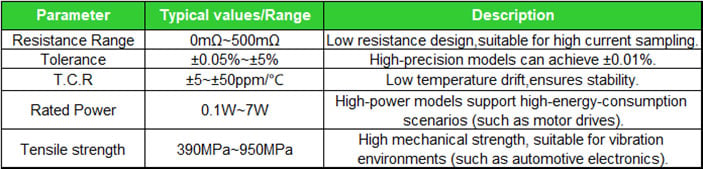
The power range is from 0.1 W to ¾ W, and the operating temperature can reach -55℃ to +170℃.
Core Performance Parameters
Applications of Alloy Resistors
Battery Management System (BMS)
Function: Real-time monitoring of charge and discharge current, preventing overcurrent/short circuits, and supporting coulomb counter calculation of battery capacity.
Solution: Utilizing high-precision manganese-copper alloy resistors (e.g., resistance below 0.004 Ω) paired with a high-side detection circuit.
Power Supply and Motor Control
Switching Power Supply: Overcurrent protection, dynamic load adjustment (e.g., USB-PD charger)
Motor Drive: Current sampling in three-phase inverters, supporting field-oriented control (FOC)
Industrial Automation
Inverter and PLC: Monitoring motor load, enabling fault diagnosis and energy efficiency optimization
4-20 mA Current Loop: High-reliability signal transmission, electromagnetic interference resistant design
Automotive Electronics
Electric Vehicle Drive System: Inverter current monitoring, supporting ISO 26262 automotive standard
On-Board Charger (OBC): High-temperature resistant, vibration-resistant design, adaptable to complex operating conditions
Selection Guidelines
Resistance and Power Matching
For high-current applications (e.g., motors), select models with low resistance (0.1 mΩ~10 mΩ) and high power (≥0.5 W).
For precision measurement applications, prioritize manganese copper or nickel-chromium alloys to ensure a temperature coefficient ≤±20 ppm/℃.
Packaging and Mounting
For high-density PCBs, use surface mount packages (e.g., 3720). Pay attention to the soldering process (pressor design improves soldering stability).
For high-power applications, use bare die packages for stronger current carrying capacity and better performance when combined with a heat dissipation solution.
Environmental Adaptability
For high-temperature environments (e.g., electric heating equipment), use nickel-chromium or iron-chromium-aluminum alloys (temperature resistance up to 500℃).
Alternatively, choose bare die series with heat sinks, as shown in the package example below:
 An example of a bare alloy resistor with a heat sink. (Image source: Milliohm Electronics)
Advantages of Alloy Resistors
The advantages of alloy resistors include:
High Stability: Alloy materials (such as manganese copper) have low annual variation rates, resulting in strong long-term reliability.
Fast Response: Low inductance design (<10 nH), suitable for high-frequency pulse circuits.
Versatile Applications: Covering the needs of all industries, from consumer electronics to aerospace.
DigiKey carries a wide variety of Milliohm Electronics resistors to suit design needs.
Acerca de este autor

Shenzhen Milliohm Electronic established in 2009,is a national high-tech enterprise. We boasts advanced resistor production equipment,electron beam welding lines and technology, capable of mass-welding alloy materials ranging from 0.1 mm to 4 mm. We operates four factories in Foshan,Anhui,Suzhou and Zhongshan,with a total production area exceeding 20,000m². Our products are widely used in industries including automotive electronics,industrial equipment,telecommunications,rail transportation,power and BMS,home appliances,metering and measuring instruments,medical devices,and consumer electronics.

Have questions or comments? Continue the conversation on TechForum, Digi-Key's online community and technical resource.
Visit TechForumMás blogs de este autor